Four Media for Equity Players Driving the Future of Startups in Mexico
Four Media for Equity firms are reshaping Mexico's startup ecosystem by exchanging media exposure for equity and helping founders scale faster.


Imagine that instead of paying for advertising and brand exposure, your startup receives a high-impact multimedia campaign, and instead of signing a purchase order, you exchange a portion of your company. No cash changes hands. No debt is created. Just a shared bet: if your company grows, so does your media partner. That is the essence of the Media for Equity (M4E) model. Although it originated in Europe more than three decades ago, Mexico is rapidly emerging as one of the most dynamic hubs for this investment model in Latin America.
The timing is no coincidence. In an ecosystem where nearly three million startups are founded each year and 80% fail within their first 18 months, the biggest challenge is no longer building a product—it's getting noticed. Artificial intelligence has shortened the time required to replicate software functionality from approximately 18 months to just 2.4 weeks. As a result, the product itself is no longer the primary competitive moat. Brand recognition, reputation, and community have become the new strategic advantages. This is precisely where Media for Equity is proving its value.
Four firms, each with a distinct but complementary investment thesis, are leading this transformation from Mexico across Latin America. Each focuses on a different stage of a startup's journey, a different audience, and a unique interpretation of what it truly means to invest in visibility.
ILB Media Ventures: Giving B2B Startups the Visibility They Deserve
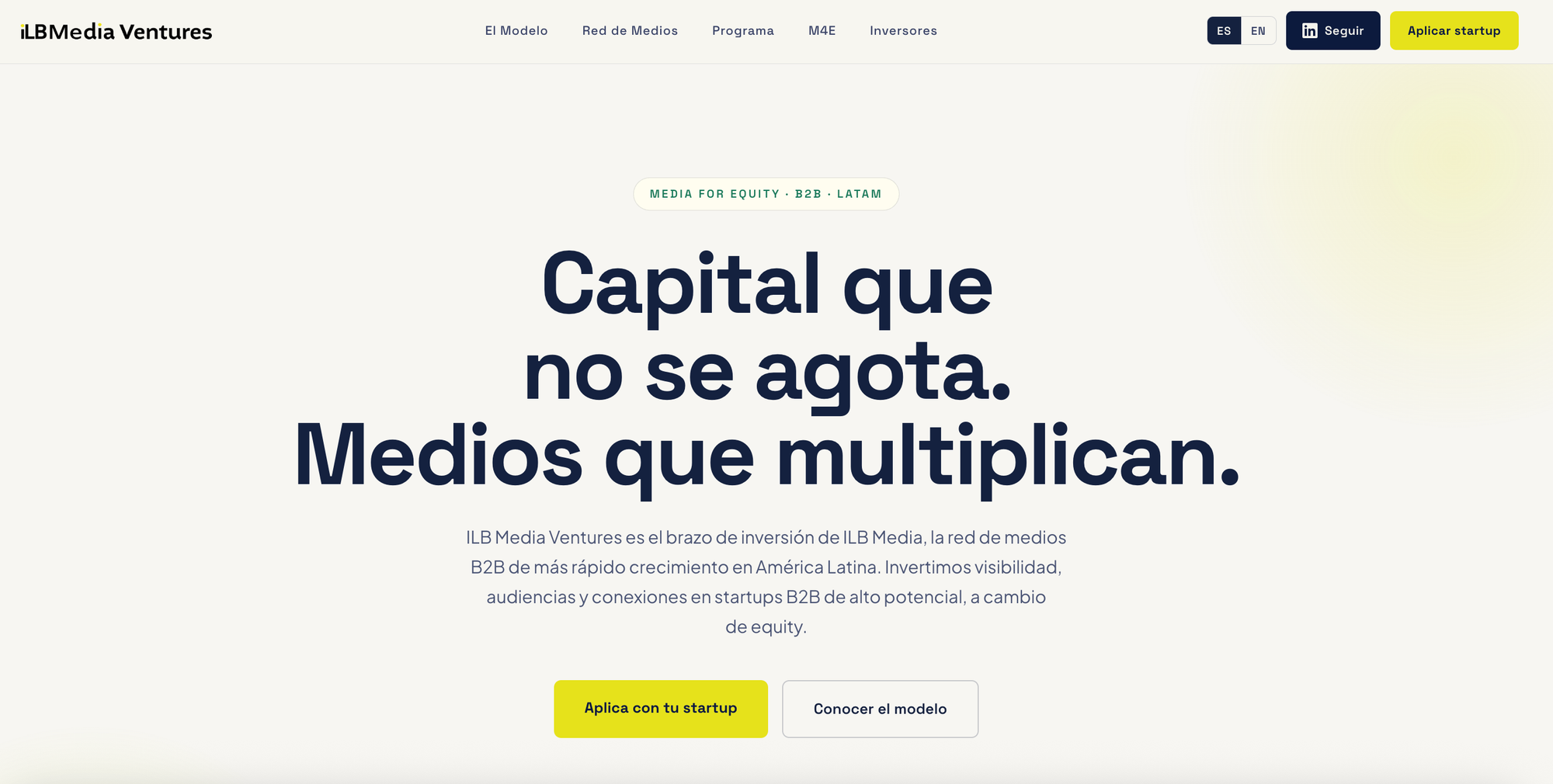
For years, Media for Equity largely focused on consumer startups, television campaigns, mass audiences, and products sold directly to consumers. Few considered SaaS founders, enterprise software companies, or fintechs selling to corporate clients, until ILB Media Ventures entered the market.
Positioned as the first and only Media for Equity firm dedicated to early-stage B2B startups in Latin America, ILB Media Ventures follows a fundamentally different strategy. Rather than targeting millions of consumers, it focuses on reaching the executives who influence millions of dollars in business decisions.
The firm leverages a network of business media outlets, industry events, and market intelligence platforms designed for CEOs, investors, family offices, and corporate decision-makers, an ecosystem that collectively oversees more than US$3 billion in annual business activity.
For a B2B startup, securing visibility in front of a mid-sized company's CEO, a venture capital partner, or a corporate procurement executive often creates far greater value than generating millions of generic social media impressions. A well-positioned article, an industry ranking, or an executive interview can open commercial opportunities that would otherwise require months of outbound sales efforts.
As the investment arm of ILB Media Group, one of Latin America's fastest-growing business intelligence media companies, ILB Media Ventures is redefining the Media for Equity model by proving that strategic visibility does not need to be massive to be transformative.
Nascent Media: Institutionalizing the Media for Equity Model
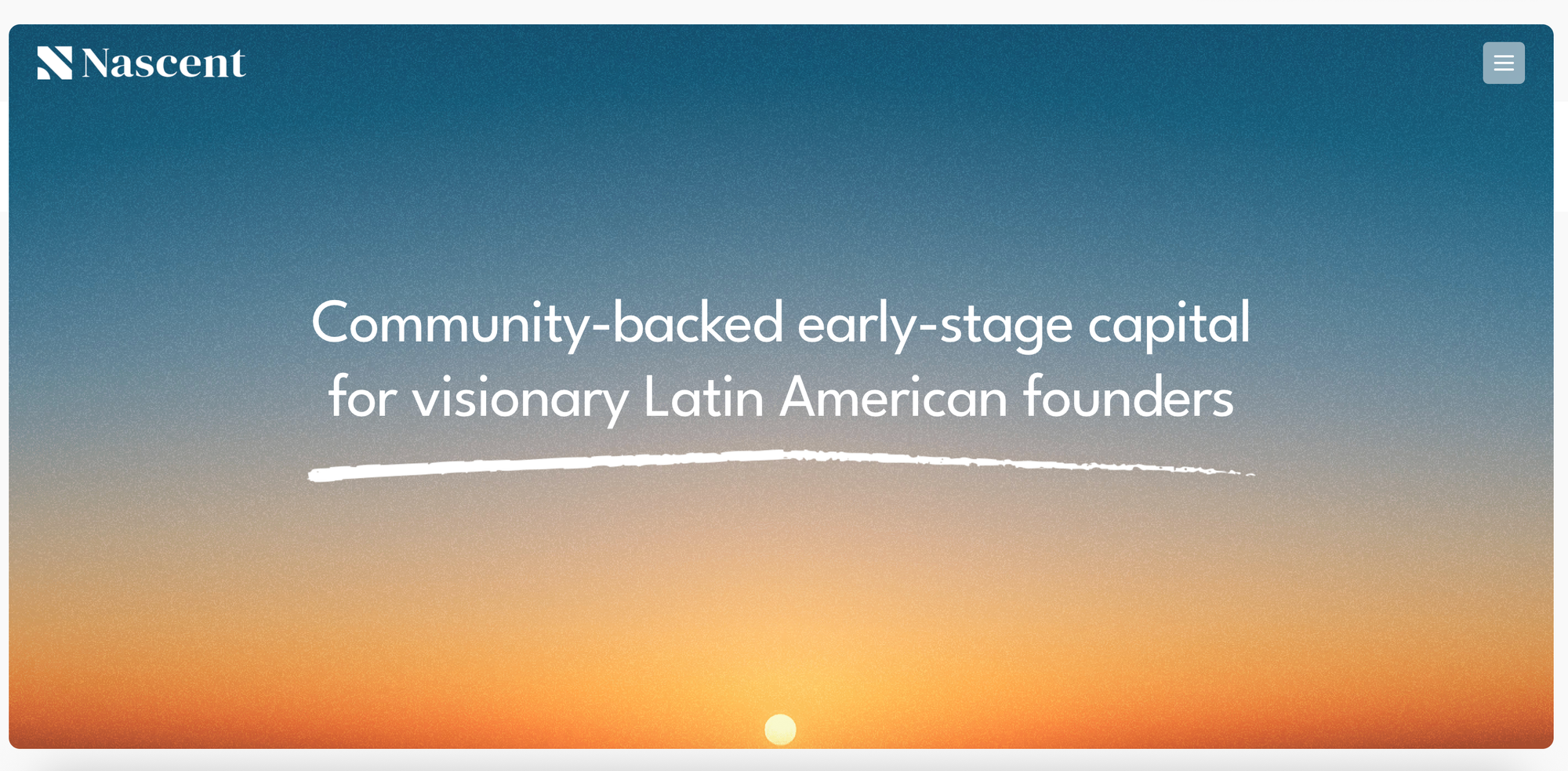
If ILB Media Ventures represents specialization, Nascent Media represents institutionalization.
While many Media for Equity initiatives across Latin America emerged as natural extensions of media companies looking to monetize unused advertising inventory, Nascent Media stands out as one of the region's few investment funds purpose-built around the M4E model.
This distinction matters because investment funds bring disciplined portfolio construction, rigorous due diligence, structured investment processes, and long-term return expectations.
Led by Victor Noguera, a well-known figure within Mexico's technology ecosystem, Nascent Media operates at the intersection of venture capital and media, combining expertise from both industries.
Rather than simply contributing advertising inventory, the fund applies clear investment criteria. In a model where every startup with early traction may appear attractive, disciplined selection becomes essential to building a portfolio capable of generating meaningful returns rather than simply distributing advertising campaigns.
Beyond investing in startups, Nascent Media is helping professionalize the Media for Equity ecosystem in Latin America by connecting two industries that have historically operated under very different business models.
Grupo Fórmula: Turning Media Reach Into a Growth Engine
No discussion of Media for Equity in Mexico is complete without Grupo Fórmula.
As one of the country's largest media conglomerates, with operations spanning radio, television, digital platforms, and live events, Grupo Fórmula has become the most active Media for Equity player in Mexico.
Its nationwide audience gives the company an advertising inventory whose strategic value extends far beyond the commercial price of airtime.
Grupo Fórmula's investments begin at approximately US$1 million, placing its Media for Equity agreements among the largest in the country and giving startups access to campaigns capable of fundamentally changing their growth trajectory.
The company's proposition goes beyond advertising. By becoming an equity holder, Grupo Fórmula aligns its incentives with those of the startup, sharing a common objective: building stronger brands and accelerating growth.
For founders entering a national expansion stage, partnering with Grupo Fórmula means more than launching a marketing campaign—it means accessing decades of audience trust and the credibility associated with one of Mexico's most recognized media organizations.
UnionBravo: Scaling Category Leaders Across the Spanish-Speaking Market
Every successful startup eventually reaches an inflection point where product-market fit has been achieved, traction is established, and the next challenge is scaling rapidly enough to dominate its category.
For startups at that stage, UnionBravo offers one of the largest Media for Equity platforms in the Spanish-speaking world.
As the Media for Equity arm of TelevisaUnivision, the world's largest Spanish-language media company, UnionBravo focuses exclusively on growth-stage businesses.
Its investments begin at US$5 million, targeting companies that have already validated their business model and now require large-scale visibility across Latin America and the U.S. Hispanic market.
Its portfolio includes some of the region's most recognized technology companies, including Kavak, Rappi, Ualá, Clip, Kueski, and QuintoAndar.
To date, UnionBravo has deployed more than US$300 million through the Media for Equity model.
TelevisaUnivision reaches over 100 million Spanish-speaking viewers across Mexico, the United States, and Latin America, providing a distribution network that traditional venture capital firms simply cannot replicate.
Beyond television ratings and prime-time advertising, UnionBravo offers startups something even more valuable: cultural relevance.
Appearing across TelevisaUnivision's media properties transforms a startup from "just another app" into a familiar brand woven into the everyday conversations of millions of households. For sectors such as fintech, mobility, and e-commerce—where consumer trust is often the most difficult asset to build—that level of recognition can prove significantly more valuable than any performance marketing campaign.
Visibility Has Become Strategic Infrastructure
Mexico's Media for Equity landscape is becoming increasingly well defined.
These four firms represent four distinct investment philosophies and four different approaches to startup growth. Yet they all share one belief: visibility is no longer simply a marketing expense—it has become strategic infrastructure.
As more startups compete for the same attention, the companies that scale may no longer be distinguished solely by the quality of their technology. Their success may instead depend on who is amplifying their story—and whether that story reaches the people capable of changing the trajectory of their business.